

Spravato
Nervana Medical offers Spravato® treatment for adults with treatment-resistant depression and major depressive disorder with suicidal thoughts. Administered in-clinic under close medical supervision, Spravato is an FDA-approved nasal spray that works differently from traditional antidepressants, often providing faster symptom relief. At Nervana Medical, patients receive personalized, compassionate care in a certified setting, with full monitoring, insurance support, and a dedicated care team guiding each step of treatment.

What Is Spravato?
Spravato® (esketamine) is a prescription nasal spray used to treat severe depression when other antidepressants have not worked. This is called treatment-resistant depression (TRD). It is also approved for adults with major depression who have active suicidal thoughts or behaviors.
Spravato is FDA-approved and is usually used along with an oral antidepressant, although in some cases it may be used on its own.
How Is Spravato Different From Regular Antidepressants?
Most antidepressants (like SSRIs and SNRIs) work by changing levels of chemicals such as serotonin or norepinephrine, and they can take weeks to start helping.
Spravato works completely differently.
It targets a brain pathway involving glutamate, which plays a key role in mood, learning, and brain connections. By doing this, Spravato helps the brain:
- Form new, healthier connections
- Improve communication between brain cells
- Restore areas of the brain affected by chronic depression
Because of this, many patients feel improvement within hours to days, not weeks.
How Is Spravato Given?
- Spravato is taken as a nasal spray in the clinic
- It is not taken at home
- You use the spray under medical supervision
After treatment, patients must stay in the clinic for at least 2 hours so the care team can monitor for side effects and ensure safety.
What Does a Typical Treatment Schedule Look Like?
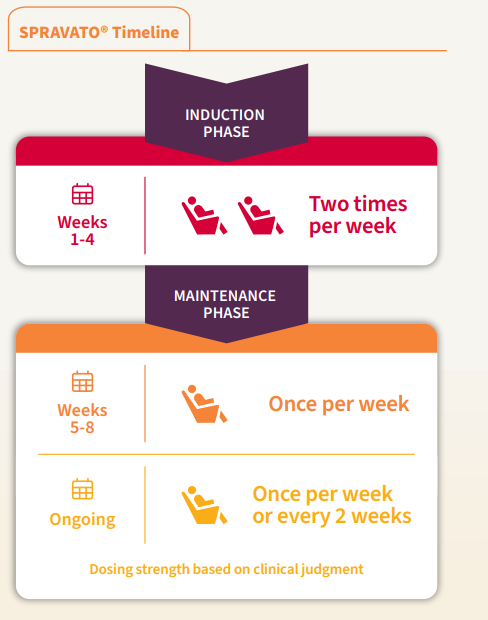
For treatment-resistant depression:
- Weeks 1–4 (Induction Phase):
Treatment twice weekly - After that (Maintenance Phase):
Treatment once weekly or every other week, depending on response
The dose is typically 56 mg or 84 mg, adjusted by your provider.

What Side Effects Should Patients Expect?
Most side effects are temporary and happen on treatment days only.
Common effects include:
- Feeling disconnected or “floaty”
- Dizziness
- Sleepiness
- Mild nausea
- Temporary increase in blood pressure
These effects usually peak within the first hour and wear off by the end of monitoring. This is why patients cannot drive the same day and must have a ride home.
Importantly, Spravato has a very low risk of sexual side effects, unlike many traditional antidepressants.
Is Spravato Safe?
Yes, when used as directed.
Spravato is only available through a special FDA safety program (REMS), which means:
-
It can only be given in certified clinics
-
Patients are carefully monitored
-
Providers are specially trained
Large clinical trials have shown Spravato to be effective and safe for long-term use when properly supervised.
Why Do Patients Choose Spravato?
Patients often choose Spravato because:
- Other antidepressants did not work
- They need faster relief
- They want an option with fewer sexual side effects
- They feel “stuck” despite years of treatment
Many patients report improvements in mood, motivation, clarity, and hope, sometimes after just a few treatments.
What Do Insurance Companies Usually Require to Approve Spravato?
Insurance companies want to be sure that Spravato is being used for patients who truly need it. Most payors require three main things
1. A Diagnosis of Major Depression
You must have a diagnosis of major depressive disorder (MDD) or treatment-resistant depression, meaning your depression has been ongoing and significantly affecting your daily life.
2. Proof That Other Antidepressants Didn’t Work
Most insurance plans require that you have tried at least two different antidepressant medications in the past, taken:
-
At an appropriate dose
-
For long enough (usually 6–8 weeks each)
These medications did not provide enough relief, or caused side effects that made them unsafe or intolerable.
This helps insurance confirm that Spravato is being used after standard treatments were unsuccessful.
3. Ongoing Mental Health Monitoring
Insurance companies also typically require that:
-
You are actively followed by a qualified mental health provider
-
Your symptoms are tracked using standardized depression questionnaires
-
Spravato is given in a certified medical clinic with appropriate monitoring
This ensures the treatment is safe, medically necessary, and effective.
Important Things Patients Should Know
-
Approval is not instant. Insurance authorization can take days to a few weeks.
-
Denials are common at first, but many are overturned with additional documentation.
-
Your care team handles the paperwork and appeals on your behalf.
-
Approval requirements vary slightly between insurance plans.
Why Is There a Waiting Period?
Spravato is a powerful, specialized treatment. Insurance companies require extra steps to make sure it is:
-
Medically appropriate
-
Used safely
-
Provided in the correct clinical setting

Short-Term Clinical Trial Results (4 Weeks)
Spravato® Used With an Oral Antidepressant
In a 4-week clinical study, patients received either:
- Spravato® plus an oral antidepressant, or
- A placebo nasal spray plus an oral antidepressant
Results showed that patients treated with Spravato® and an oral antidepressant experienced a faster and greater reduction in depression symptoms compared to those receiving placebo with an oral antidepressant.
Key findings included:
- Significant improvement in symptoms as early as 24 hours
- Continued improvement throughout the 4-week study period
- Most symptom relief occurred early, with sustained benefit over time
Spravato® Used Alone
In a separate clinical study, patients were randomly assigned to receive either:
- Spravato® alone, or
- A placebo nasal spray
Patients treated with Spravato® alone experienced significantly greater improvement in depression symptoms at both 24 hours and 4 weeks compared to placebo.
Improvements were measured using standardized clinical depression rating scales.
Long-Term Effectiveness and Relapse Prevention
Spravato® has also been evaluated in a long-term maintenance study to determine whether benefits are sustained over time.
In this trial:
- Patients who continued Spravato® treatment were significantly less likely to experience a return of depressive symptoms (relapse)
- Outcomes were compared between patients who remained on Spravato® plus an oral antidepressant and those who transitioned to a placebo nasal spray with an oral antidepressant
These results suggest that ongoing Spravato® treatment can help maintain symptom improvement and reduce relapse risk in appropriate patients.
Below is a clear, patient-friendly explanation you can use for a blog, FAQ, or consultation discussion. It is written to be neutral, accurate, and easy to understand.
How Is Ketamine Different From Spravato®?
Ketamine and Spravato® are related treatments, but they are not the same. While both can help with depression, they differ in form, approval status, how they’re given, and how insurance covers them.
How Is Ketamine Different From Spravato®?
Ketamine and Spravato® are related treatments, but they are not the same. While both can help with depression, they differ in form, approval status, how they’re given, and how insurance covers them.
1. FDA Approval
Spravato® (esketamine)
-
FDA-approved specifically for:
-
Treatment-resistant depression (TRD)
-
Depression with acute suicidal thoughts or behaviors
-
-
Must be given under a strict FDA safety program (REMS)
Ketamine
-
FDA-approved as an anesthetic, not specifically for depression
-
When used for depression, it is considered off-label
-
Still widely used in mental health with growing evidence
-
2. What They’re Made Of
Spravato®
-
Contains esketamine, which is one specific part (the “S-enantiomer”) of ketamine
-
Designed and studied specifically for depression treatment
Ketamine
-
Usually racemic ketamine, meaning it contains two mirror-image forms of the drug
-
Has broader effects and has been used in medicine for decades
-
3. How They’re Given
Spravato®
- Nasal spray
- Always administered in a REMS certified clinic
- Patients stay for at least 2 hours of monitoring
- Cannot be taken home
Ketamine
- Can be given in different ways depending on the clinic:
- IV infusion
- IM injection
- Oral lozenge or troche
- Monitoring requirements vary by route and clini
4. Insurance Coverage
Spravato®
- Often covered by insurance, including many commercial plans and Medicare
- Requires prior authorization and documentation
Ketamine
- Typically not covered by insurance for depression
- Most patients pay out of pocket
5. Treatment Structure
Spravato®
- Follows a standardized schedule:
- Twice weekly during the first month
- Weekly for weeks 5-8
- Weekly or every 2 weeks maintenance
- Dosing and frequency are tightly regulated
Ketamine
- Treatment plans are more flexible and individualized but it is typically recommended to do a series of 6 IV or IM within 2-3 weeks
- Follows a standardized schedule:
6. Experience and Side Effects
Combining ketamine injections with therapy can be a truly transformative solution. The ketamine helps your body and mind relax, allowing you to gain insight into the root cause of your emotional issues and work through them in a safe environment.
Through our integration download post-session aids in incorporating insights and experiences into everyday life, we do advise that clients collaborate with an external therapist to reach the full potential of their healing.
SPRAVATO FAQs
What is SPRAVATO® (esketamine)?
SPRAVATO® is a prescription nasal spray indicated for adults with treatment-resistant depression (TRD), either alone or with an oral antidepressant. It is also indicated for depressive symptoms in adults with major depressive disorder (MDD) and suicidal thoughts or behaviors, in conjunction with an oral antidepressant. (Spravato)
Is there a difference between SPRAVATO® (esketamine) Nasal Spray CIII and a ketamine infusion?
SPRAVATO® (esketamine) CIII nasal spray is the S-enantiomer of racemic ketamine. SPRAVATO® is an FDA-approved nasal spray for treatment-resistant depression (TRD) and major depressive disorder (MDD) with acute suicidal ideation or behavior (MDSI). Ketamine has not been approved by the FDA to treat depression. There are no head-to-head studies comparing esketamine and ketamine infusion. Both SPRAVATO® and ketamine are Schedule III controlled substances under the U.S. Controlled Substances Act.
What should patients expect during a consultation?
A consultation includes a review of medical history, evaluation of treatment goals, and assessment of whether SPRAVATO® is an appropriate option. Insurance eligibility and prior authorization are often initiated at this visit. (Spravato)
How is SPRAVATO® administered?
Patients self-administer the nasal spray under the supervision of a healthcare provider in a certified healthcare setting. A typical treatment schedule includes twice-weekly administration for the first four weeks, then weekly or every other week thereafter based on clinical response. (Spravato)
What safety monitoring is required?
Due to risks of sedation, dissociation, respiratory depression, and increases in blood pressure, patients must be monitored by a healthcare professional for at least two hours after each dose before being released from the treatment setting. (Spravato)
Can patients drive after a session?
No. Patients should not drive, operate machinery, or perform other activities requiring alertness until at least the next day after a restful sleep, because of the potential effects on cognition and motor function. (Spravato)
What are common side effects?
Side effects may include feelings of disconnection (dissociation), dizziness, nausea, sleepiness, spinning sensations, anxiety, numbness, increased blood pressure, vomiting, and headache. These effects usually occur after dosing and resolve the same day. (Spravato)
What medical conditions should clinicians consider before prescribing?
Patients with heart or brain problems (including hypertension, history of stroke or aneurysm), psychosis, pregnancy, or those who are breastfeeding require careful evaluation due to potential risks. (Spravato)
Is SPRAVATO® covered by insurance?
Many commercial plans, Medicare, and Medicaid cover SPRAVATO® when medical necessity criteria are met, though coverage and out-of-pocket costs vary by plan. (Spravato)
What is the REMS program?
SPRAVATO® is only available through the SPRAVATO® Risk Evaluation and Mitigation Strategy (REMS). This program ensures healthcare settings and pharmacies are certified and that patients are enrolled, to manage risks like sedation, dissociation, and respiratory depression. (spravatorems.com)
What happens if a patient misses a dose of SPRAVATO®?
If a patient misses treatment sessions, provided there is no worsening of their depressive symptoms, the patient should continue the current dosing schedule.
For patients who miss treatment sessions during maintenance treatment and have worsening of depression symptoms, per clinical judgment, consider returning to the previous dosing schedule (if doses missed during weekly dosing, revert to twice-weekly dosing).
Can my patients pick up SPRAVATO® at their pharmacy and self-administer at home?
No, under the REMS, SPRAVATO® must be administered in a certified healthcare setting. Due to the possibility of delayed or prolonged sedation or dissociation in some cases, patients should be monitored by a healthcare provider for at least 2 hours following each treatment session, or until the clinician determines the patient is safe to leave.
SPRAVATO® is also administered under REMS due to the potential for abuse and misuse. Consider the risks and benefits of prescribing SPRAVATO® prior to using in patients at higher risk of abuse. Monitor patients for signs and symptoms of abuse and misuse.
Does SPRAVATO® prevent suicide?
The effectiveness of SPRAVATO® in preventing suicide or in reducing suicidal ideation or behavior has not been demonstrated. Use of SPRAVATO® does not preclude the need for hospitalization if clinically warranted, even if patients experience improvement after an initial dose of SPRAVATO®.
How soon can I drive after taking SPRAVATO®?
Caution patients that SPRAVATO® may impair their ability to drive or operate machinery. Instruct patients not to engage in potentially hazardous activities requiring complete mental alertness and motor coordination, such as driving a motor vehicle or operating machinery, until the next day after a restful sleep.
The Key Difference: How Much Reaches the Brain
- Spravato® (esketamine) is a nasal spray
- Only about 40–50% of the medication is absorbed
- It delivers a controlled, targeted effect
- Designed to minimize sedation while still treating depression
- Ketamine (IV or IM) enters the bloodstream directly
- Nearly 100% bioavailability
- Produces a stronger and more immediate effect
- Often results in deeper dissociation and sedation
Important Clarification for Patients
Stronger does not mean better.
- Some patients respond very well to Spravato® and prefer the gentler experience
- Others need the intensity of ketamine to achieve symptom relief
- The goal is effectiveness and safety, not intensity
Both treatments can be highly effective when matched to the right patient.
Which One Is Better?
Neither is universally “better.” The right option depends on:
- Insurance coverage
- Severity and urgency of symptoms
- Prior treatment response
- Medical history
- Patient preference
- Provider Recommendations
Some patients respond better to one than the other. Others may try both at different points in their care.
The Bottom Line
If you have:
- Long-standing depression
- Tried multiple antidepressants without success
- Are working with a qualified provider
You may be a strong candidate for insurance-approved Spravato treatment.
Our team will guide you through every step and advocate for you with your insurance company.
 Download Patient Brochure
Take the following Surveys to better determine if you are a candidate for Spravato Treatment!