L-taurine is a non-essential amino acid that is abundantly present in various tissues throughout the body. It plays a multifaceted role in numerous physiological processes. L-taurine is involved in regulating osmolarity and electrolyte balance, supporting cardiovascular health by promoting proper heart function and regulating blood pressure.
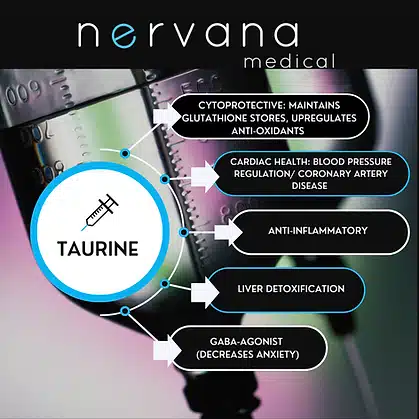
Uses: Cardiovascular support, inflammation reduction, blood pressure improvement, nervous system support, metabolic support (reduce triglycerides, prevent obesity, improve insulin resistance, regulate glucose metabolism, lower cholesterol, and reduce blood pressure), improvement in periodontal disease, athletic performance, mood stabilization and improvement, cognitive performance , prevention of chronic demyelinating eye d/o, immunity, hepatitis, congestive heart failure, cystic fibrosis,fatigue, reducing oxidative stress, insomnia, psychosis, and anemia. Taurine helps support nerve growth as well as proliferation or neural progenitor cells and synapse formation in brain regions required for long-term memory.
Basic Information
The Lipo-B (MIC) injection is a product that contains a combination of compounds that have been shown to exhibit lipotropic effects. The lipotropic effects facilitate the burning of adipose tissue within the human body which may, consequently, result in some degree of weight loss. Lipo-B injections are typically used as fat loss supplements, in combination with diet and exercise, in weight loss plans. The combination of products that make up the Lipo-B (MIC) injection are methionine, choline, and cyanocobalamin (vitamin B12).
General Information/Mechanism of Action
Studies strongly suggest that taurine supplementation, even when taken short-term; may support better physical function, mitigate the cardiovascular risks that can be present after exercising, and improve issues associated with heart failure.Taurine may accomplish this by reducing inflammation and lowering blood pressure. Some research suggests that taurine may calm the nervous system and even improve the function of the left ventricle of the heart. Although more studies must be conducted to confirm these benefits; the research already conducted is promising for anyone concerned with cardiac health or suffering from heart disease.
A meta-analysis review published in the journal Food & Function found, after analyzing animal and human studies; that taurine has an effective action against the symptoms of metabolic syndrome. The study found that Taurine may reduce triglycerides, prevent obesity, improve insulin resistance, regulate glucose metabolism, lower cholesterol, and reduce blood pressure.
Taurine might also help heal the damage from periodontal disease. Patients with chronic periodontitis were observed to determine if taurine could help the healing process. It was determined that taurine significantly improved the healing process. According to this research, it may have done so by enhancing levels of lipid peroxidation products and antioxidant enzymes.
A study conducted at the University of Stirling evaluated athletes who ran middle distance races before and after they consumed supplemental taurine. The test-subjects consumed 1,000 milligrams of taurine two hours before running, and they were checked to confirm that there was no effect on the athlete’s respiratory system, heart rate or blood lactate levels. Afterward, 90% of the runners showed faster times. According to this research; there is a 99.3% chance that taurine was responsible for the improved performance of the athletes during the time trial.
Other studies indicate that taurine may have a powerful mood-boosting effect when combined with caffeine. Scientists have found strong evidence that a combination of taurine and caffeine may improve mood and possibly boost cognitive performance.
Taurine is one of the most copious amino acids in the human eye; where it exceeds the concentration of any other amino acid. Consequently, recent studies have found that maintaining high levels of taurine is important to prevent the degeneration of cells in the eye.
Adverse Reactions/Side Effects
Taurine is an amino acid that the body synthesizes naturally and is considered a nonessential amino acid. As a naturally produced substance in the body; studies on Taurine have confirmed few adverse effects when consumed in doses of up to 3 grams. When taken in reasonable doses, taurine causes no side effects; at higher doses it can cause a relaxation effect.
Interactions
There are several medications that may interact with taurine. Please be aware of the following:
- Lithium: Because taurine may have a diuretic effect, it may decrease how well lithium is excreted. This can leave serious side effects as lithium levels may be increased in the body.
- Antiplatelets: Therapy modification should be considered due to the chance of increased adverse effects of antiplatelet medication. Bleeding may occur.
- Anticoagulants: Therapy modification should be considered due to the chance of increased adverse effects of anticoagulant medication. Bleeding may occur.
- NSAIDs: Therapy modification should be considered due to the chance of increased adverse effects of NSAIDs. Bleeding may occur.
- Salicylates: Therapy modification should be considered due to the chance of increased adverse effects of salicylates. Bleeding may occur.
- Thrombolytic agents: Therapy modification should be considered due to the chance of increased adverse effects of thrombolytics. Bleeding may occur.