
If you’ve spent any time on Ozempic, Wegovy, Mounjaro, or Zepbound, you already know the trade-off no one warned you about. The scale moves. Your clothes fit. And then, often within months, your face starts to look like it lost the weight first. Hollow under the eyes, flatter through the cheek, softer along the jawline. A face you don’t quite recognize when you walk past a mirror.
The medical-aesthetic world has been catching up to this fast. In July 2025, Galderma, the dermatology company behind Sculptra, Restylane, and Dysport, released the final nine-month data from a Phase IV clinical trial. The question they asked was specific: if you treat the facial changes that follow GLP-1 weight loss with a combination of a biostimulator (Sculptra) and a hyaluronic-acid filler (Restylane Lyft or Contour), do the results hold up over time, and do patients like what they see?
The short answer was yes. Here’s what the study found, where it falls short, and how our Sculpt and Lift Intro and Sculpt and Lift Rejuvenation packages were designed around the kind of regimen this study validates.
What the study did
The trial was a multi-center, open-label Phase IV study conducted at two sites in the U.S. Participants had experienced facial volume loss after taking one of four brands of GLP-1 receptor agonists. They were treated using something Galderma calls the SHAPE Up Holistic Individualized Treatment (HIT) protocol, a flexible framework that lets the injector tailor doses and product choice to the patient sitting in the chair, rather than forcing everyone through identical syringes.
The treatment cadence looked like this:
- First visit: Sculptra plus either Restylane Lyft or Restylane Contour, for cheek augmentation and contour correction.
- Week 4: A second Sculptra treatment, with an optional Restylane Lyft or Contour touch-up.
- Week 8: An optional third Sculptra treatment.
- *Typical sculptra treatments consist of 2 vials per treatment; typical Sculptra needs are 1 vial per decade of life.
Patients were then followed out to nine months: Weeks 28 and 40 for those who got two Sculptra sessions, Weeks 32 and 44 for those who got three.
What the 9-month data showed
A few things stood out in the final results.
The regimen produced measurable, objective improvements in skin quality. Not just “the face looks fuller” but changes captured with bioinstrumentation. Restylane improved skin hydration. Sculptra significantly improved skin radiance through Month 9. That second finding matters because the “Sculptra glow” has historically been an injector observation, not something you could put a number on. This study put a number on it.
Patients liked the result, and they kept liking it. Satisfaction was strong at Week 4 and held through Month 9:
- 85.7% said their face looked less gaunt or sunken.
- 88.6% loved how the treatment maintained their facial structure.
- 88.6% loved Sculptra’s regenerative effects.
- 88.6% felt they looked better than before the regimen.
- 91.4% said they would recommend it to others after weight loss or to anyone with loose, sagging facial skin.
Safety lined up with what’s already known about these products from earlier pivotal trials. No treatment-related adverse events were reported in the press release.
Why this matters for the GLP-1 patient
Most patients on these medications aren’t worried about whether Sculptra works in general. That’s been established for years. They’re worried about something more specific: will the result still look good once I’m at maintenance weight? and am I going to need to keep coming back forever? A nine-month durability signal is one of the more useful data points we’ve had on that question, because it covers the period when most people on GLP-1s have either stabilized at their goal weight or are well into maintenance.
It also lines up with the broader scientific literature on what happens to the face during medication-driven weight loss. The same loss of subcutaneous fat that makes you look less full also makes underlying laxity more visible. Replacing volume with hyaluronic acid alone tends to fix the mirror at month one. Combining it with a biostimulator like Sculptra, which prompts your own collagen to rebuild, addresses the structural piece that’s usually the real problem.
How Sculpt and Lift Intro maps to the evidence
Our Sculpt and Lift Intro package is built for patients who are early in their GLP-1 journey, or who’ve noticed the first signs of volume loss but aren’t dealing with profound structural change yet. It includes:
- One syringe of dermal filler to restore immediate contour where it’s been lost: typically cheek, midface, or jawline.
- Three vials of biostimulator (Sculptra or Radiesse), spaced out across multiple sessions to gradually rebuild collagen and structural support.
Compare that to the trial protocol, which paired a hyaluronic-acid filler at the first session with two to three biostimulator treatments over eight weeks. Sculpt and Lift Intro is the real-world version of that standard regimen. Three biostimulator vials gives the injector room to dose across two or three appointments, the same cadence the trial used. The HA filler addresses the immediate “where did my cheek go” problem. The biostimulator addresses what’s happening underneath the skin over the following months.
This is why we structured it as an introductory package rather than a one-off appointment. The trial’s strongest finding wasn’t about a single visit. It was about the layered, sequenced approach producing durable results, which takes more than one syringe.
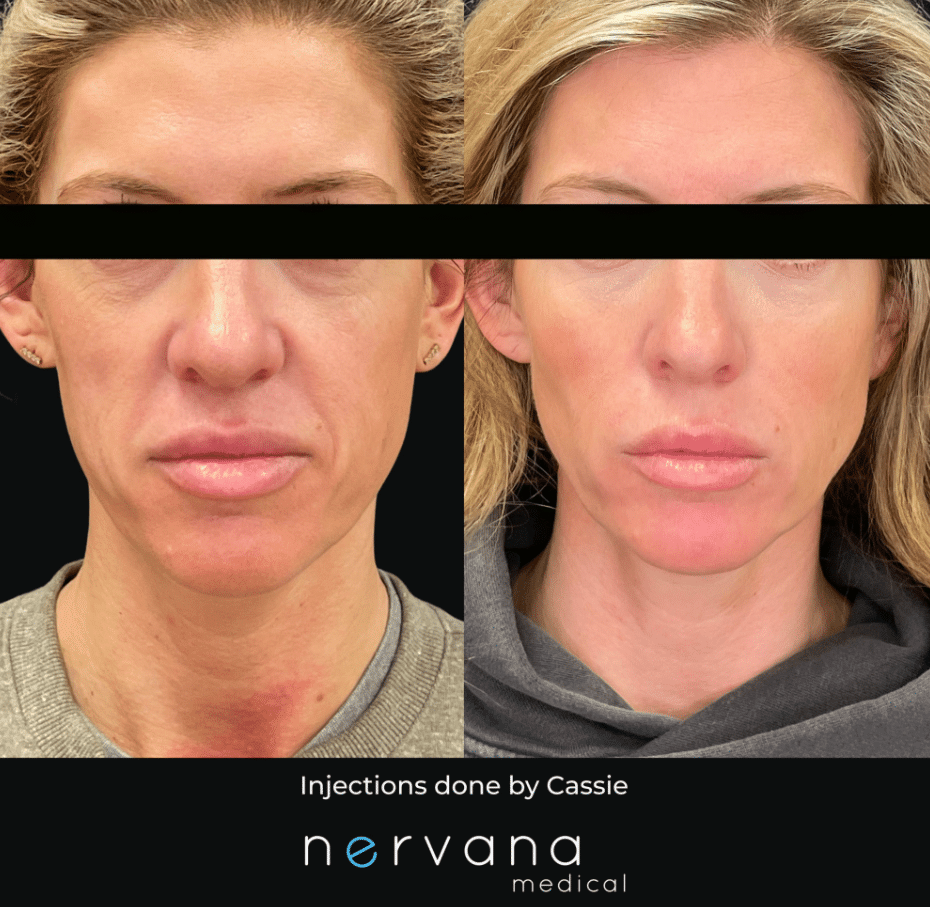
- 4 weeks after 2 vials of Sculptra and 2 syringes of Restylane Contour Dermal Filler- The start of the Sculpt and Lift-Rejuvenation Package (2 more vials of sculptra will be completed at 6-8 weeks and we will likely bank the 5th for an annual maintenance).
How Sculpt and Lift Rejuvenation extends the protocol
For patients with more significant volume loss, whether from a larger total weight drop, longer time on a GLP-1, or simply a face that’s structurally more affected, we built Sculpt and Lift Rejuvenation. It includes:
- Two syringes of dermal filler for more comprehensive contour work across multiple zones (e.g., midface and jawline together, or cheek plus temples).
- Five vials of Sculptra for a deeper, longer-arc collagen rebuild (if you do not need all 5, then 1 could be saved for your annual Sculptra maintenance!)
The reason this exists as a separate package: the trial protocol was designed around moderate volume loss. Patients who’ve lost 50, 80, or 120 pounds frequently need more than the minimum protocol to look like themselves again. Five Sculptra vials lets us extend the biostimulator course beyond the study’s 8-week window, typically over four to five sessions, so collagen rebuilding continues through the period when patients on GLP-1s are still actively losing or maintaining at lower weight. Two filler syringes lets us address multiple zones rather than picking one.
The principle the study validated, biostimulator plus HA filler sequenced over weeks, is what these packages are built around.
The Sculptra timeline: when you’ll actually see results
One thing patients ask early and often: when will I see this? Here’s how I describe it: it’s like buying the designer purse and leaving it in the closet for the first few months before you actually get to carry it. Sculptra is unusual in aesthetic medicine because the result you walk out with on day one is mostly water, not the actual treatment. The visible work happens over months, as your own collagen rebuilds in response to the poly-L-lactic acid scaffolding.
A reasonable timeline to set expectations against:
- Right after injection: Temporary fullness from water dilution and swelling. This goes away within 24 to 72 hours.
- 2 to 6 weeks: Early collagen signaling begins. You probably won’t see much yet.
- 6 to 12 weeks: First visible improvement in skin texture, firmness, and subtle volume.
- 3 to 6 months after the final session: Peak collagen remodeling and maximal aesthetic improvement.
- Up to two years or more: Gradual maintenance phase before the effect tapers.
Skin quality and thickness improvements tend to show up earlier in the curve. Structural volumization and lift mature later. Patients with significant skin laxity, a smoking history, or older collagen biology often peak closer to the longer end of that range.
Clinically, we reassess at roughly 6 to 8 weeks after each Sculptra session, and then again about 4 to 6 months after the full series is complete. That second checkpoint is when most patients see what the treatment actually did.
One nuance worth knowing: the biologic activity of PLLA and the visible aesthetic peak don’t always line up. Histologic collagen remodeling keeps going past the point where patients think they’ve “maxed out” cosmetically. This is part of why the Galderma study’s nine-month follow-up was useful. It captured the period when Sculptra is doing its quietest work.
What the study does well
Before we get into where the evidence falls short, here’s what makes it useful.
It’s the first study of its kind. Until this trial, most of what we knew about treating GLP-1-related facial changes came from case series, expert opinion, and extrapolation from existing volume-loss data. A controlled, multi-center trial in this specific patient population is new.
Nine months is a meaningful follow-up window. Many aesthetic studies report at three months, sometimes six. Nine months captures the period when biostimulator effects are fully expressed and when most weight-loss patients have reached or are maintaining their goal.
It used objective measurement, not just patient self-report. The bioinstrumentation showing skin hydration and radiance improvements is independent of how a patient happens to feel in the mirror that day. Aesthetic outcomes are very susceptible to subjective bias, so that matters.
Multiple patient-reported outcomes were tracked. Rather than one summary “are you happy?” question, the study captured satisfaction across several dimensions: gauntness, structural maintenance, regenerative effects, overall appearance, willingness to recommend.
Safety profile was consistent with prior trials. No new adverse-event signals emerged, which matters when you’re taking established products into a new patient population.
The treatment framework is published and consensus-backed. A separate international Delphi consensus on managing aesthetic needs in this population, published in JCD in 2025, reinforces that the approach being studied isn’t an outlier. It’s becoming standard.
Where the study falls short
You won’t find these listed in the Galderma press release. They’re worth thinking about anyway.
It was sponsored by Galderma, the company that makes both Sculptra and Restylane. Industry-funded trials aren’t automatically suspect, and Phase IV trials are designed to look at real-world performance, but the conclusions, study design, and reporting choices all sit inside that context.
It was open-label, meaning patients and investigators knew what was being administered. There’s no blinding, which means placebo effect and observer bias both have room to run, especially on subjective satisfaction outcomes.
There was no control or comparison arm. We can’t tell from this data whether the Sculptra-plus-Restylane combination outperforms Sculptra alone, Restylane alone, a different biostimulator, or a different filler. The study answered “does this work?” not “does this work better than alternatives?”
The sample is small. The reported satisfaction percentages back-calculate to roughly 35 patients (88.6% = 31/35, 85.7% = 30/35). That’s a typical Phase IV size, but it limits how confidently you can generalize.
Only two U.S. sites participated. Findings from two clinical practices may not represent every patient demographic, every skin type, or every clinical setting.
Patient-reported outcomes are subjective. “Felt they looked better” is a real outcome (patients should feel better), but it’s not the same as a blinded third-party photo assessment.
Nine months is informative, not lifetime durability. Sculptra’s collagen-stimulating effect is generally cited as lasting two-plus years, but this study doesn’t carry that out. Patients should expect to revisit treatment over time.
The patient population was a self-selected aesthetic group, which tends to bias satisfaction outcomes upward in any cosmetic trial.
What this means for you, sitting in our office
We’re not going to claim this study proves Sculpt and Lift will work for every patient. No study can do that. What it does is two things. It adds high-quality evidence that the combination approach we’ve been using (biostimulator plus HA filler, layered over multiple visits) produces durable, well-tolerated, well-liked results in the patient population now showing up in aesthetic practices everywhere: people whose faces have changed visibly during medication-driven weight loss. And it gives us a published treatment cadence we can map our packages to.
If you’re early in your GLP-1 journey, Sculpt and Lift Intro gives you a study-aligned protocol at the lower end of intensity. If you’ve lost more weight, or your face is showing more structural change than volume change, Sculpt and Lift Rejuvenation gives us the room to extend the regimen into something proportionate to what you need.
Either way, the conversation starts with a consult, not a package commitment. We’ll look at your face, ask about your weight-loss timeline, talk through what you’re noticing in the mirror, and figure out which protocol and products fit. That’s the SHAPE Up principle the study used, and it’s how we’ve always practiced.
Book a Sculpt and Lift consult and we’ll walk you through it in person. *Limited time promo (more than $1,000 of savings!)
Source: Galderma. “Galderma unveils final nine-month data showing lasting efficacy and patient satisfaction with its Injectable Aesthetics portfolio when addressing facial aesthetic changes after medication-driven weight loss.” July 17, 2025.