Hot flashes do not tell us which decade your ovaries are in. A missed period does not either. At Nervana Medical, perimenopause and menopause get different plans on purpose. The fork is simple: estrogen is a menopause tool. If you are not there yet, we do not add it just because you are hot at night.
This is not another explainer of what HRT is. That is already on the site. This is how we decide which side of the line you are on, and why the first prescription is often not estradiol.
How do we tell perimenopause from menopause?
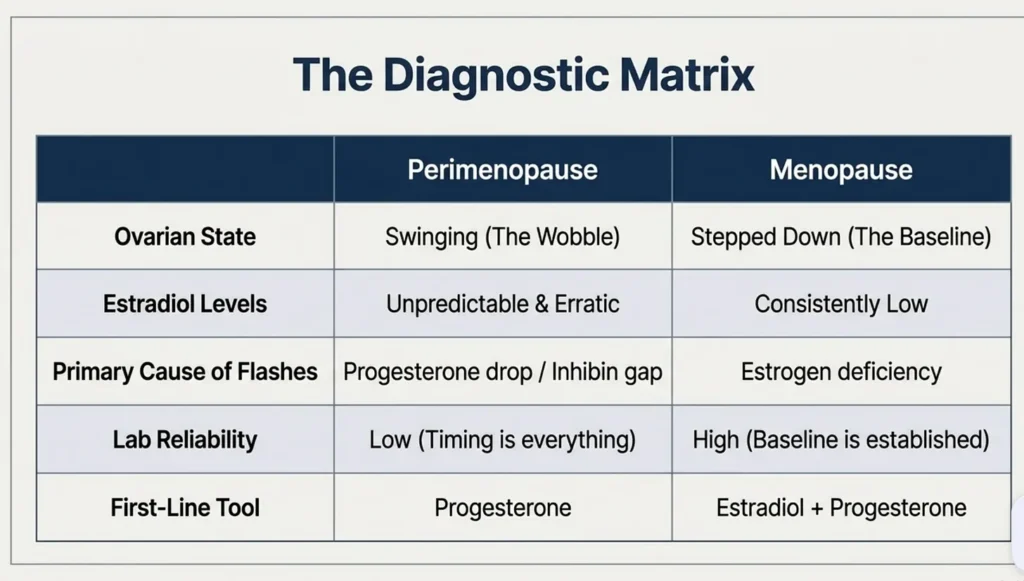
Perimenopause is the stretch when cycles get less predictable and hormones swing. Sleep, mood, cycle length, and temperature can all change while you are still ovulating some months and not others. Estradiol in that window is a swing hitter. One blood draw can look low on Tuesday and mid-range two weeks later. That is why we do not treat a random estradiol in a cycling woman as a diagnosis.
Menopause is typically one of two things:
- Twelve months with no period, and no other explanation
- Or an FSH consistently over 50
Textbooks often lean on the twelve-month rule alone. We still use it. We also use FSH because a quiet uterus is not the same as a quiet ovary. Anovulation can stop bleeding for months and still not be menopause. If we treat that as estrogen deficiency, we add estradiol to a woman who is not estrogen-deficient. That is the mistake this post is here to prevent.
Symptoms come first. Labs are a guide. If you are 47, sleeping badly, and spotting two weeks after a heavy flow, we do not wait for a perfect FSH to take you seriously. We also do not start estradiol on a hunch.
Why is estradiol menopause-only here?
Estradiol replacement is for the woman whose ovaries have actually stepped down. In menopause, estradiol stays low. That is when we measure it, and that is when we consider replacing it.
In perimenopause, estradiol is often still being made, just not on a reliable schedule. Adding more on top of a swing is how people get more breast tenderness, more migraines, and more chaos, not fewer flashes. We do not draw estradiol to “see if you need estrogen” while you are still cycling. It will look low a lot of the time. That is a timing problem, not a prescription.
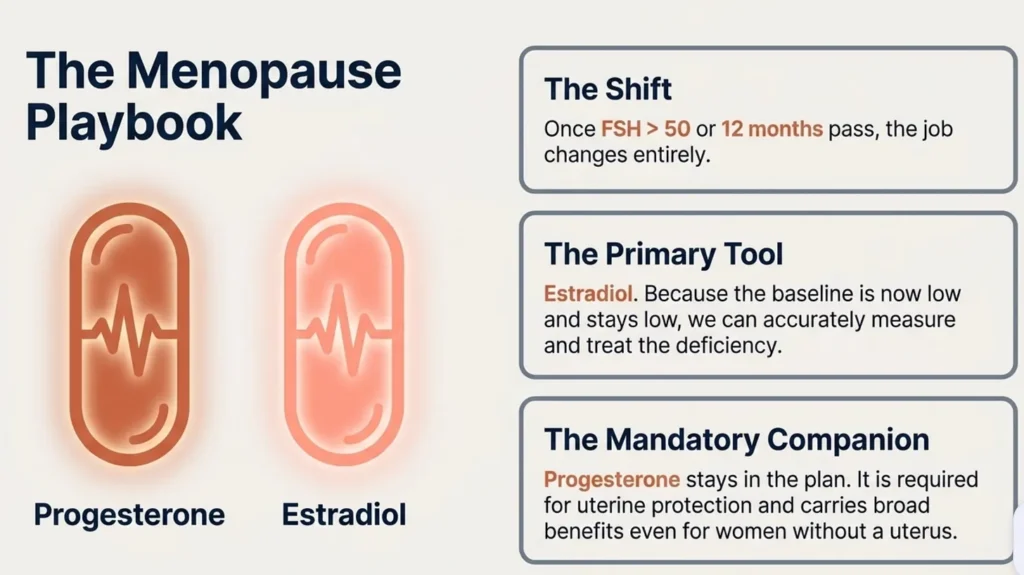
If you still have a uterus and you later start estradiol, you still need progesterone. That rule does not change.
What do we do with hot flashes before menopause?
If you are not menopausal and you are flashing, that is usually not an estrogen-deficiency problem. The signal is often a progesterone and ovulatory problem, sometimes described as the inhibin gap: the ovary is wobbling, not empty. In that setting we treat with progesterone, not estrogen.
Progesterone is also the hormone we time carefully if we are drawing it. A luteal-phase number means something. A random Tuesday number usually does not. When it is hard to schedule the perfect timing, we take notes of where you are in your cycle, and look at trends and symptoms.
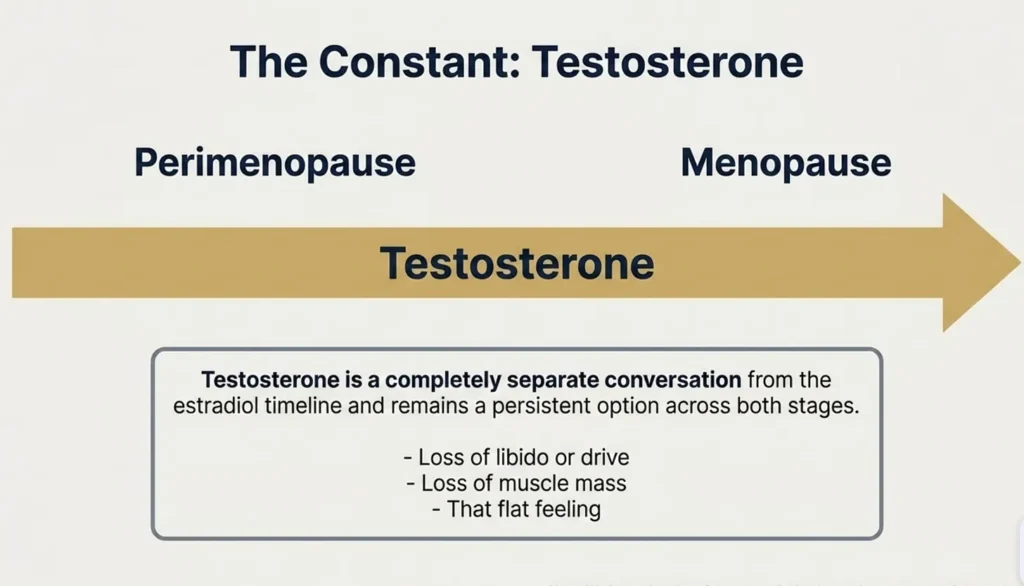
Testosterone can still be part of a perimenopause plan when libido, drive, muscle, or that flat feeling is the complaint. That is a different conversation from estradiol. We have already written about why women need testosterone too.
What changes once you are actually in menopause?
Once FSH is over 50, or it has been a year without a period, the job shifts. Estradiol can come into the plan because the baseline is now low and stays low. We monitor it then, because we are treating a deficiency we can actually measure. Progesterone stays in the plan if you have a uterus and sometimes even if you don’t, because it carries more benefits than just uterine protection. Testosterone stays on the table if the symptoms call for it.
We still do not chase a single “normal” on a printout. We treat how you feel, then use the labs to see whether the plan is doing what we asked. Doses are individual.
What if I already stopped bleeding but I am not sure why?
Tell us. A silent period after an IUD, after a progesterone-only pill, after a year of scanty cycles, or after a lot of stress is not automatically menopause. We will look at FSH, the rest of the story, and whether this is anovulation that wants progesterone, or menopause that is ready for estradiol.
If you are under 40 with cycle change and flashes, we do not call that ordinary perimenopause. That is a different workup.
Frequently asked questions
Can I be in perimenopause with a normal FSH?
Yes. FSH is more useful as it climbs toward menopause. A mid-range FSH does not cancel your symptoms.
Does a missing period mean I should start estrogen?
No. A missing period can be anovulation. In our clinic that is a progesterone conversation until menopause is actually established.
Will progesterone stop my flashes before menopause?
That is the first tool we use for non-menopausal flashes. It is not a promise that every night sweat disappears. It is the honest first move instead of stacking estrogen you do not need.
Do I have to wait twelve months to get help?
No. You do not have to wait twelve months to be taken seriously. You may have to wait for menopause before estradiol is the right hormone.
Book the right plan, not the same plan, in Sandy, UT
A useful hormone visit is a stage check, not a product pitch. We will tell you whether this looks like perimenopause, menopause, or something else, and we will not hand you a medication just because a friend got it.
Book a consult at Nervana Medical, 8899 South 700 East #125, or call (801) 335-5243.
Start with our hormone therapy page if you want the broader picture first.
Related reading