Most people know Botox and other neuromodulators for smoothing forehead lines and crow’s feet. Fewer know that plastic surgeons have been studying the same medicine for another job: helping facial wounds heal into flatter, narrower, less noticeable scars. If you have a scar on your forehead, brow, or around your mouth, or you’re healing from a cut or a procedure on your face, here is what the research on Botox for scars actually says and what it doesn’t.
Key Takeaways
- Tension is a scar’s enemy. Muscles pulling on the edges of a healing wound can keep it inflamed longer and push it toward a thicker, raised (hypertrophic) scar.[1]
- Botulinum toxin type A (BoNT-A) temporarily relaxes those muscles, which lowers the pull on the wound while it heals.[1]
- Research also points to possible effects on scar cells themselves, including the fibroblasts that lay down scar tissue, though most of that evidence comes from lab and early studies.[1]
- Timing and dose are still being studied. Many studies treat early in healing, often with smaller, targeted doses than cosmetic treatment, but there’s no settled “best” timing or dose.[2] [3] [5]
- Pooled randomized trials show modest but real improvements in scar appearance, scar width, and patient satisfaction for postoperative facial scars, with no significant increase in complications.[2] [3]
- It’s not a guarantee or a stand-alone fix. Results depend on scar type, age of the scar, location, and timing. Individual results vary.
How Scars Form, and Why Muscle Pull Matters
Every wound heals in overlapping phases: inflammation, new tissue formation, and then a long remodeling phase where the scar slowly matures. According to a review by Al-Qattan and colleagues in the Annals of Saudi Medicine, the face is a special case because many facial muscles attach directly into the skin.[1] Each time you frown, raise your eyebrows, or smile, those muscles tug on the edges of a healing wound.
That repeated tension matters. The review describes how tensile forces on wound edges can prolong the inflammatory phase and worsen hypertrophy, meaning the scar becomes thicker, wider, redder, and more raised.[1] This is one reason a scar running across the forehead, where the frontalis muscle is constantly lifting the brows, can heal differently than one in a lower-motion area.
“Less pull on the wound while it heals can mean less micro-trauma to the scar, and that is the core idea behind using a neuromodulator for scars.”
What Botulinum Toxin Type A Does in Wound Healing
Botulinum toxin type A works through chemo-denervation: it temporarily blocks the nerve signal that tells a muscle to contract.[1] In cosmetic treatment, that’s what softens expression lines. Around a healing wound, the same effect lowers the tension on the wound edges. Al-Qattan and colleagues describe this as a kind of temporary “chemical immobilization” of the area while the scar forms.[1]
The review also looks at mechanisms beyond muscle relaxation. Researchers have explored whether BoNT-A may act directly on scar fibroblasts, the cells that make collagen, and influence how they grow and behave, potentially contributing to a better-quality scar.[1] Lab studies add detail. In fibroblasts taken from hypertrophic scars, botulinum toxin type A slowed cell growth and lowered TGF-β1, a signaling protein that drives scar formation and fibrosis.[6] A follow-up lab study found it also reduced CTGF, a downstream “scar-building” signal.[7] In plain English: the medicine may quiet some of the signals that tell scar cells to overproduce collagen, which could support more orderly remodeling over time.[1] [6] [7] Researchers have also noted calmer inflammation around wounds and, in a small study of hypertrophic scars, less redness and itching after treatment.[1] [8]
These cellular findings are promising, but they mostly come from laboratory and early clinical work, so they help explain why toxin might help rather than proving how much it helps in any one person.
The same review also discusses BoNT-A in the management of hypertrophic scars and as an add-on in cleft lip repair, where minimizing tension on the upper lip repair is especially important.[1]
Does Timing Matter?
Researchers are very interested in when to treat. Studies have injected at different points: before surgery, during the procedure, shortly after wound closure, and around suture removal.[2] [3] In one blinded, placebo-controlled trial from Mayo Clinic, patients with forehead cuts or excisions received toxin into the nearby muscles within 24 hours of closure, and their scars were rated as better-looking than the placebo group’s.[5] The idea is simple: relax the muscle before tension has a chance to shape the new scar. Treating within the first few days is commonly discussed, but the ideal timing hasn’t been settled.[2] [3]
How Much Is Used?
For fresh surgical wounds, studies generally use small, targeted amounts placed in the muscles pulling on the wound, often lower than a typical cosmetic forehead treatment.[2] [3] Reported doses vary widely between studies, so there is no standard “scar dose.” Your dose is individualized at consultation.
What the Clinical Trials Show
Since that 2013 review, several research groups have pooled randomized controlled trials (RCTs) to see whether the theory holds up in real patients:
- Postoperative scars, 17 RCTs (633 cases): Compared with control, botulinum toxin groups had better scar scores on standard scales (Vancouver Scar Scale and visual analog scale), thinner scar width, and higher patient satisfaction, with no significant difference in adverse events.[2]
- Postoperative facial scars, 10 RCTs (114 cases): Toxin injection was linked to better scar appearance scores and smaller scar width, again without a significant difference in complications.[3]
- Hypertrophic scars and keloids: Results here are promising but come from smaller studies, so the evidence is thinner than for cosmetic uses. A meta-analysis of randomized and prospective controlled trials found intralesional BoNT-A outperformed placebo on scar scores and width, and compared favorably with corticosteroid injection on some measures.[4]
A few important caveats keep this honest. Many included trials were small, used different doses and timing, and measured scars on different scales. Most of the strongest data involves injecting soon after surgery or injury to prevent a thick scar, rather than treating an old, mature scar.[2] [3] Keloids in particular can be stubborn and often need a multi-treatment plan.
Case Photo: Forehead Scar After Neuromodulator Scar Treatment
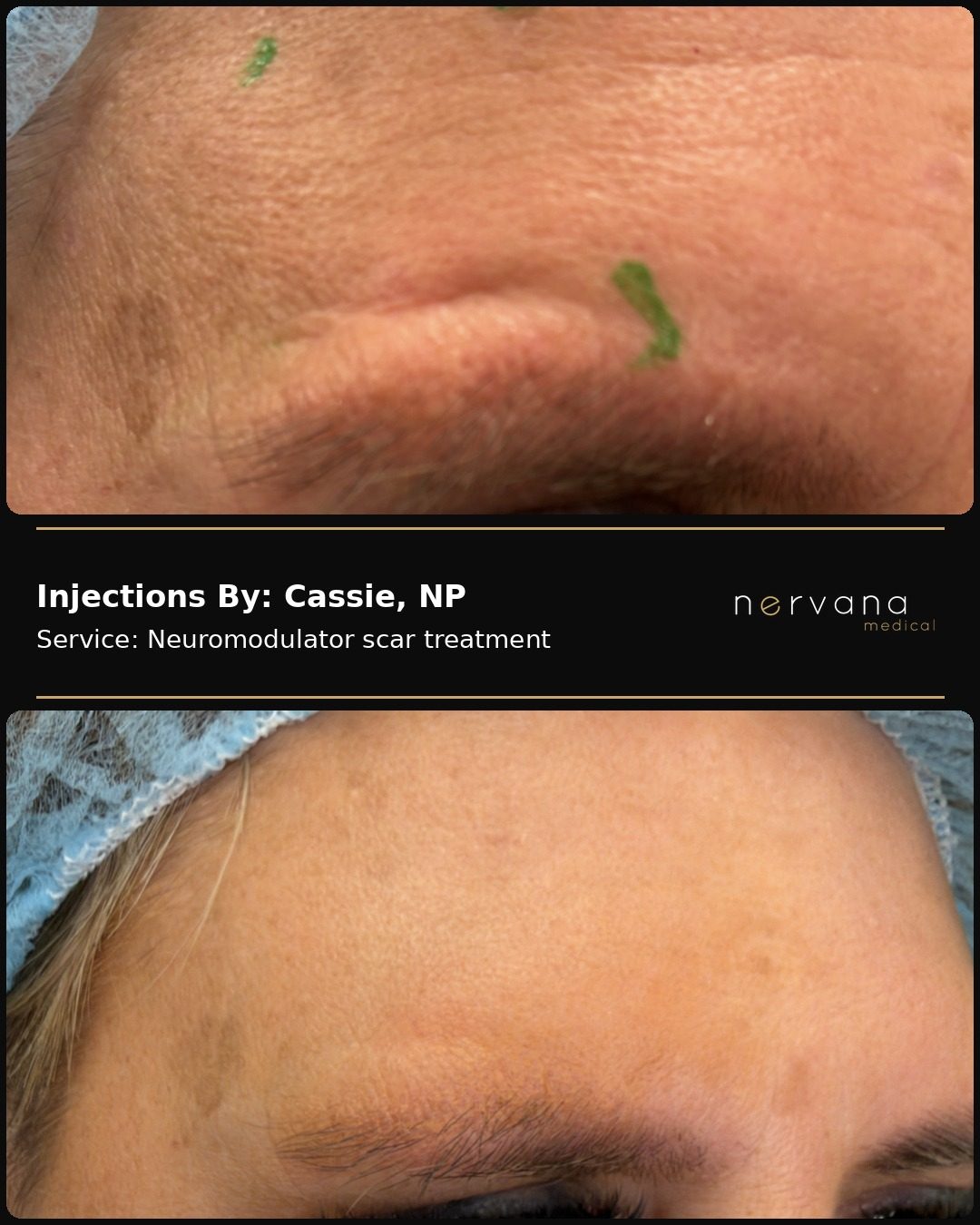
This patient came in with a noticeable, raised scar above the brow, an area where the forehead muscle is constantly moving. After neuromodulator scar treatment, the scar looks visibly flatter and smoother and blends more naturally into the surrounding skin. See the full case in our gallery.
Disclaimer: Photos show one patient’s individual result and are not a guarantee. Outcomes depend on scar type, age, location, skin, and healing. Treatment plans are customized at consultation. Shared with patient consent.
Who Might Be a Good Candidate?
Neuromodulator scar treatment may be worth discussing if you have:
- A recent facial wound or surgical incision, especially on the forehead, brow, between the brows, or around the mouth, where muscle movement pulls on the scar
- A scar that’s starting to look raised, wide, or thick
- A scar you’re already treating with other options (silicone, laser, microneedling) and want to support with less tension
It’s usually not the right fit if you’re pregnant or breastfeeding, have certain neuromuscular conditions, or have an active infection at the treatment site. Your provider will review your health history first. Open wounds need to be evaluated, and timing is coordinated with your surgeon or wound care plan.
How We Approach It at Nervana Medical
At Nervana Medical in Sandy, our aesthetic injectors use FDA-approved neuromodulators, including Botox, Dysport, Jeuveau, and Letybo. These are clinic context: the studies above tested botulinum toxin type A broadly, and using these products for scars is off-label.
A typical plan starts with a consultation to look at the scar, how the surrounding muscles move, and how far along it is in healing. From there, our providers map small, precise doses into the muscles that pull on the scar. Scar treatment is often combined with other options for the best overall result, and we’ll talk honestly about what to expect.
Frequently Asked Questions
Does Botox for scars make an old scar disappear?
No treatment erases a scar. Research is strongest for using toxin during healing to help a scar form flatter and narrower.[2] [3] Older or mature scars may still improve when muscle pull is part of the problem, but they often do best with a combination plan.
Is it safe?
In the pooled trials, botulinum toxin groups did not show a significant increase in complications compared with controls.[2] [3] As with any injection, temporary bruising, tenderness, or unwanted weakness of nearby muscles is possible, which is why placement matters.
How soon after an injury or surgery can it be done?
Many studies injected within days to weeks of surgery or wound closure.[2] [3] The right timing depends on your wound and your surgeon’s plan, so we coordinate it at your consultation.
Is the dose the same as cosmetic Botox?
Usually not. Scar studies often use smaller, targeted amounts, and doses vary from study to study.[2] [3] Your plan is customized at consultation.
Does it help keloids?
A meta-analysis found intralesional botulinum toxin helped hypertrophic scars and keloids compared with placebo.[4] Those studies were smaller, though, keloids can recur, and they usually need a layered plan.[4] [8]
Is it the same as cosmetic Botox?
It’s the same type of medicine, but the goal and placement are different. For scars, the aim is to relax the specific muscles pulling on the wound rather than to smooth wrinkles.
Book a Consultation in Sandy, UT
Curious whether a neuromodulator could help your scar heal softer and flatter? Book a consultation with our aesthetic injectors at Nervana Medical in Sandy, UT, or call (801) 335-5243.
This article is for education only and isn’t medical advice. Individual results vary.
References
- Al-Qattan MM, Al-Shanawani BN, Alshomer F. Botulinum toxin type A: implications in wound healing, facial cutaneous scarring, and cleft lip repair. Ann Saudi Med. 2013;33(5):482-488. doi:10.5144/0256-4947.2013.482. PMID: 24188943. https://pmc.ncbi.nlm.nih.gov/articles/PMC6074896/
- Qiao Z, Yang H, Jin L, Li S, Wang X. The efficacy and safety of botulinum toxin injections in preventing postoperative scars and improving scar quality: a systematic review and meta-analysis. Aesthetic Plast Surg. 2021;45(5):2350-2362. doi:10.1007/s00266-021-02196-5. PMID: 33674930. https://pubmed.ncbi.nlm.nih.gov/33674930/
- Yue S, Ju M, Su Z. A systematic review and meta-analysis: botulinum toxin A effect on postoperative facial scar prevention. Aesthetic Plast Surg. 2022;46(1):395-405. doi:10.1007/s00266-021-02596-7. PMID: 34609526. https://pubmed.ncbi.nlm.nih.gov/34609526/
- Bi M, Sun P, Li D, Dong Z, Chen Z. Intralesional injection of botulinum toxin type A compared with intralesional injection of corticosteroid for the treatment of hypertrophic scar and keloid: a systematic review and meta-analysis. Med Sci Monit. 2019;25:2950-2958. doi:10.12659/MSM.916305. PMID: 31006769. https://pmc.ncbi.nlm.nih.gov/articles/PMC6489528/
- Gassner HG, Brissett AE, Otley CC, et al. Botulinum toxin to improve facial wound healing: a prospective, blinded, placebo-controlled study. Mayo Clin Proc. 2006;81(8):1023-1028. doi:10.4065/81.8.1023. PMID: 16901024. https://pubmed.ncbi.nlm.nih.gov/16901024/
- Xiao Z, Zhang F, Lin W, Zhang M, Liu Y. Effect of botulinum toxin type A on transforming growth factor beta1 in fibroblasts derived from hypertrophic scar: a preliminary report. Aesthetic Plast Surg. 2010;34(4):424-427. doi:10.1007/s00266-009-9423-z. PMID: 19802513. https://pubmed.ncbi.nlm.nih.gov/19802513/
- Xiao Z, Zhang M, Liu Y, Ren L. Botulinum toxin type A inhibits connective tissue growth factor expression in fibroblasts derived from hypertrophic scar. Aesthetic Plast Surg. 2011;35(5):802-807. doi:10.1007/s00266-011-9690-3. PMID: 21455826. https://pubmed.ncbi.nlm.nih.gov/21455826/
- Elhefnawy AM. Assessment of intralesional injection of botulinum toxin type A injection for hypertrophic scars. Indian J Dermatol Venereol Leprol. 2016;82(3):279-283. doi:10.4103/0378-6323.173586. PMID: 27088929. https://pubmed.ncbi.nlm.nih.gov/27088929/