
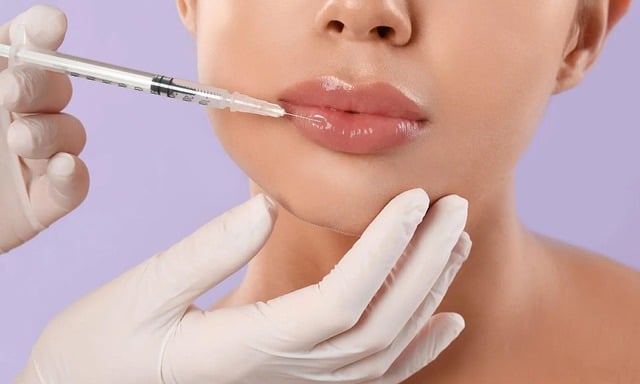
For lip filler in Sandy, UT, Most conversations about lip filler start with a syringe and a number of milliliters. Ours starts with a side view. Turn your head ninety degrees and a single reference line; drawn from the tip of your nose to the tip of your chin, tells an experienced injector more about what your lips need than a front-facing photo ever will. It is called the Ricketts E-line, and it is one of the reasons two patients with identically “thin” lips can need completely different treatment plans.
What the E-line actually measures
The esthetic line, described by orthodontist Robert Ricketts in 1950, runs from the pronasale (the nasal tip) to the soft-tissue pogonion (the forward-most point of the chin). Where your lips sit relative to that line describes the balance of your lower face in profile.
The classic reference proportions place the upper lip roughly 4 mm behind the line and the lower lip roughly 2 mm behind it; the lower lip slightly more forward, preserving the natural step between the two. Those numbers are a starting point for the conversation, not a target to hit. More on their limits below.
What matters clinically is this: the line is anchored at two moving points. The nose and the chin. Change either one and every judgment about the lips changes with it.
Why lip filler in Sandy, UT often starts with the chin
This is the part that surprises most patients. Someone comes in convinced their upper lip is too small, and on the profile view the lip is a normal distance from the line; the chin is simply set back, dragging the bottom anchor of the E-line backward with it.
Add volume to lips in that situation and the profile gets worse, not better. The lips move forward relative to a line that was never in the right place. Bring the chin forward instead, and the same lips read as balanced without a drop of product in them.
The reverse happens too. A lip that already sits at or past the line usually doesn’t need more volume, whatever the front view suggests and in some cases it needs less. Reading the profile first is the difference between a considered treatment plan and an over-treated one. It’s the central idea behind facial balancing: the face is one structure, not a list of separate complaints.
The nasolabial angle: the other half of the picture
The E-line measures how far forward things sit. It says nothing about how they tilt. For that, injectors look at the nasolabial angle, the angle between the base of the nose and the upper lip.
In women, a range of roughly 95° to 110° is generally considered balanced; in men, closer to 90° to 95°, a more horizontal transition. An angle under 90° reads as a downturned nasal tip or a protruding upper lip. An angle over 110° reads as an overly rotated nose or a flattened lip.
Cross-referencing both measurements is what isolates the real problem:(not medical advice, education only)
- Upper lip close to the line, angle acute-usually too much product already, or migration. The answer is often hyaluronidase, not more filler.
- Upper lip far behind the line, angle acute-frequently a recessed chin. Treat the chin.
- Lip far behind the line, angle obtuse– genuine volume and philtral support loss. This is the patient who actually benefits from lip filler.
- Downturned nasal tip, line unaffected– loss of deep support at the base of the nose, addressed with small, deep placement at the pyriform aperture rather than in the lip itself.
Support at the base of the nose and structural work in the premaxilla can advance the upper lip without adding any bulk to the vermilion at all. Research on premaxillary hyaluronic acid placement shows increased upper-lip projection without changing nasal tip projection; a useful option when the lip needs support rather than volume.
Where the classic numbers stop being useful
The original E-line values came from a Caucasian normative sample. Many patients; East Asian, African, Hispanic, and plenty of people who fit none of those categories neatly; carry naturally fuller, more anterior lips, and applying a single numeric target across every face produces under-correction in some patients and over-correction in others.
Age moves the line as well. The nose and chin continue to grow across the lifespan while lip volume decreases, so lips retrude relative to the E-line over time.
And the line is static. Your face is not. Lip filler can reduce how much tooth shows when you smile; desirable if you have a gummy smile, unwelcome if your smile line is already low. A profile analysis that ignores smile dynamics is only half an assessment.
Safety sets the technique, not the aesthetics
None of the planning above changes the anatomy underneath. The superior and inferior labial arteries run through the territory being treated, and perioral filler carries real vascular risk occlusion.
That is why an anatomy-first, ultrasound-guided approach matters just as much as the measurement. Knowing where a vessel actually runs in your lip, using cannulas where appropriate, injecting slowly and retrograde, and having hyaluronidase on hand for reversal are what we consider non-negotiables. The E-line tells us what to aim for. Anatomy tells us how to get there safely.
The whole-person part
Nervana Medical is an integrative practice, which means a lip consult is rarely only about lips. Hormonal changes, sleep, stress, and nutrition all show up in skin quality and facial volume, and we would rather talk about that than sell you a larger syringe. Aesthetics, wellness, and mental health sit under one roof here for a reason.
Frequently Asked Questions
How do I know if I need lip filler or chin filler?
Look at your profile, not the mirror straight on. If your lips sit well behind a line drawn from your nose tip to your chin tip and your chin looks set back, the chin is usually the structure to address first. A profile assessment during your consult settles it in about five minutes.
Can lip filler make my face look overdone?
It can, when volume is added without reference to the nose and chin. Pushing the lips past the E-line creates a convex profile that reads as over-treated even when the front view looks fine. Assessing the profile first is the simplest safeguard against that outcome.
How much lip filler do most patients need?
Published cohorts using structured lip analysis report an average first session of about 1 mL, but that figure describes a population, not a person. Your starting anatomy, your chin position, and your goals determine the amount, and starting conservatively leaves room to build.
Does the E-line apply to every face?
No; and that’s important. The original measurements were derived from a Caucasian sample, and lip position relative to the line varies meaningfully by ancestry, sex, and age. We use it as one input among several, calibrated to your face rather than to a chart.
Is ultrasound really necessary for lip filler?
It isn’t universal practice, but it changes what an injector can see. Ultrasound maps vessel course and shows existing product before a needle goes in, which matters most in the perioral area where vascular risk is highest.
Book a Lip Filler Consultation in Sandy, UT
If you’ve been considering lip filler in Sandy, UT or you’ve had filler before and something about the result never quite settled; a profile assessment is the right place to start. We’ll look at the whole lower face, explain what we see, and tell you honestly if lips aren’t the answer.
Book a consultation with Nervana Medical, or explore our full range of dermal fillers in Sandy, UT.