
Exhaustion that sleep does not fix is one of the most common complaints we hear at Nervana Medical, an integrative practice in Sandy, UT. It is also one of the most frequently mislabeled. Low ferritin symptoms get filed under stress, poor sleep, or the cost of a busy life, when the explanation is sitting in a single lab value that standard panels often leave out. Below: what ferritin actually measures, why a normal CBC does not rule out iron deficiency, when a low result becomes a red flag that needs a GI workup, and which labs to ask for.
What Ferritin Measures
Ferritin is the protein that stores iron inside your cells. Think of it as the savings account: serum ferritin reflects what is in reserve, not what is circulating in the moment. That reserve supports red blood cell production, oxygen delivery, mitochondrial energy production, neurotransmitter synthesis, and thyroid hormone conversion, which is why depletion shows up as fatigue, brain fog, exercise intolerance, cold hands, restless legs, and hair shedding long before it shows up as anemia.
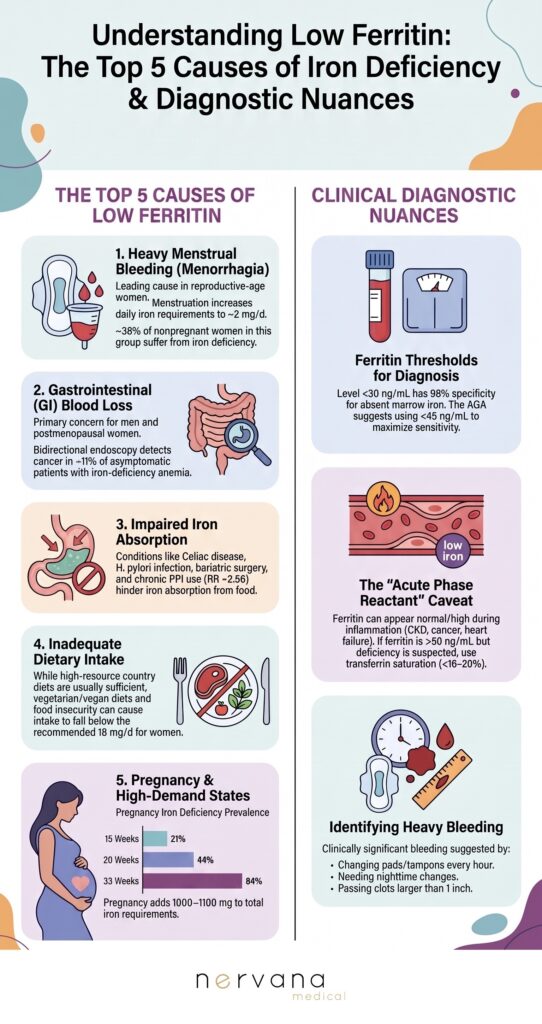
What makes ferritin unusually useful is its specificity. Many markers are ambiguous. A high white count could mean a head cold or sepsis. A low ferritin is different: iron deficiency is essentially the only thing that causes it. Clinical guidance generally treats a ferritin under 30 ng/mL as highly specific for depleted iron stores, and the American Gastroenterological Association uses a higher cutoff of 45 ng/mL so that fewer real cases get missed.
That threshold matters because most lab reference ranges start their “normal” flag far lower, sometimes at 10 or 15 ng/mL. A result of 18 ng/mL prints without a flag, and the patient gets told her labs look fine.
Optimal levels of ferritin are often noted to be above 100 ng/mL to really support areas like hair growth and fatigue.
Iron Deficiency Without Anemia: Why a Normal CBC Is Not Reassuring
The most common gap in fatigue workups is testing hemoglobin and stopping there. Anemia is the end stage of iron deficiency, not the beginning of it. Iron stores empty first, and hemoglobin holds steady for months or years while symptoms accumulate.
The scale of that gap is significant in menstruating patients. A 2023 JAMA analysis of U.S. adolescent and young adult females found that roughly 38% met criteria for iron deficiency by ferritin, while only about 6% were anemic. Older reproductive-age women were not the population studied, so the exact number should not be extrapolated, but the pattern holds in practice: iron deficiency without anemia is common, and a CBC alone will not find it.
The mechanism is not mysterious. Heavy menstrual bleeding costs roughly 0.5 mg of iron per milliliter of blood lost, which can push daily requirements toward 2 mg of absorbed iron per day. Absorption from a mixed diet runs in the range of 1 to 2 mg per day. The math does not leave much margin, and it runs monthly for decades.
Low Ferritin in Men and Postmenopausal Women Is a Red Flag
This is the part of the conversation that deserves the most weight. In a menstruating patient, low ferritin usually has an obvious source. In a man or a postmenopausal woman, it does not, and the working assumption shifts to gastrointestinal blood loss until proven otherwise.
In studies of asymptomatic men and postmenopausal women with iron deficiency anemia, bidirectional endoscopy identifies a gastrointestinal malignancy in roughly 10% of patients, a yield well above what routine screening finds in an average-risk population. Peptic ulcer disease, celiac disease, and colonic lesions account for much of the rest.
To be direct about scope: that workup belongs with primary care and gastroenterology, not a wellness clinic. If your labs fit this picture, the useful next step is a referral for endoscopy, and we will make it. Repleting iron without finding the source treats the number and leaves the cause.
Why Iron Intake Alone May Not Fix It
Intake is often not the limiting factor. Three blockers show up repeatedly:
- The dietary gap. Average intake for U.S. women runs near 13 mg per day against an RDA of 18 mg, and heme iron from animal sources absorbs several times better than non-heme iron from plants. Vegetarian and plant-forward eaters need more, not the same.
- Acid suppression. Iron requires an acidic stomach to be reduced into an absorbable form. Chronic proton pump inhibitor use raises gastric pH and roughly doubles the risk of iron deficiency in published analyses. Long-term PPI use plus unexplained low ferritin is a combination worth revisiting with your prescriber.
- Celiac disease. Around 3% of iron-deficient patients turn out to have celiac disease, which works against iron three ways at once: villous atrophy reduces absorptive surface, inflammation drives hepcidin upregulation and blocks iron transport, and occult blood loss adds to the deficit. Unexplained iron deficiency is a legitimate reason to check tissue transglutaminase IgA.
Pregnancy and the 1,000 mg Demand
Pregnancy increases total iron requirements by approximately 1,000 mg across gestation to support fetal development, placental growth, and a substantially expanded maternal blood volume. Reserves deplete on a predictable curve. In one longitudinal cohort, the prevalence of iron deficiency climbed from about 21% at 15 weeks to 44% at 20 weeks and 84% by 33 weeks.
The practical implication is timing. Ferritin checked in the first trimester, before demand accelerates, gives you a runway to correct stores. Ferritin checked in the third trimester mostly documents what has already been spent.
When a Normal Ferritin Lies
One caveat changes how the whole panel should be read. A low ferritin is nearly always meaningful. A normal or high ferritin is not always reassuring.
Ferritin is an acute-phase reactant, meaning it rises with inflammation independent of iron status. Chronic kidney disease, heart failure, autoimmune disease, obesity, infection, and recent illness all inflate the number and can mask a real deficiency underneath it. This is why an isolated ferritin is a weaker test than an iron panel.
When inflammation is suspected and ferritin sits above 50 ng/mL, the marker to look at next is transferrin saturation. A saturation below 16 to 20% points toward functional iron deficiency regardless of what the ferritin says. Running CRP alongside the panel tells you whether you are looking at a true reserve or an inflated one.
Which Labs to Ask For
A workup that actually answers the question includes ferritin, a CBC, serum iron with TIBC and transferrin saturation, and CRP to interpret the ferritin honestly.
Fatigue rarely has a single cause, which is the reason we read an iron panel next to thyroid function, B12, vitamin D, and sex hormones rather than in isolation. Low ferritin and low estradiol produce overlapping symptoms, and treating one while ignoring the other leaves the patient half better. That whole-panel approach is what hormone replacement therapy evaluations at our clinic are built around, and it is why we operate as an integrative med spa in Sandy, UT rather than a single-service practice.
If labs point toward nutrient repletion, we would refer you to our registered dietician to help formulate a nutrition plan , the follow-up question is absorption. For some patients oral iron taken correctly is enough. For others, whose absorption is compromised or whose gut cannot tolerate oral dosing, it is worth discussing whether IV and IM therapy fits the picture better.
Frequently Asked Questions
What is a good ferritin level?
Most labs flag “low” somewhere between 10 and 15 ng/mL, which is too permissive for symptomatic patients. Clinical guidance treats under 30 ng/mL as consistent with depleted stores, and the AGA uses under 45 ng/mL to avoid missing cases. Many patients report symptom improvement once ferritin is restored well above those cutoffs, so the target is set with your symptoms, not the lab’s flag. Our optimal is above 100 ng/mL.
Can you be iron deficient if your hemoglobin is normal?
Yes, and it is common. Iron stores deplete before hemoglobin falls, so a normal CBC rules out anemia but says nothing about your reserve. This is called iron deficiency without anemia, and ferritin is the only way to detect it.
Why is my ferritin normal but I still feel exhausted?
Two possibilities. Inflammation may be inflating your ferritin and hiding a real deficiency, which is why transferrin saturation and CRP matter. Or iron is not the driver, and thyroid function, B12, vitamin D, sleep quality, or hormone status deserves a closer look.
Can low ferritin cause hair loss?
Low ferritin is associated with increased hair shedding, particularly in menstruating women, though the evidence on exactly where the threshold sits is mixed. If diffuse shedding is the presenting concern, checking ferritin is reasonable and inexpensive, and correcting a real deficiency is a prerequisite for any other hair treatment working.
How long does it take to raise ferritin?
Repletion is measured in months, not weeks. Rebuilding stores typically takes 8 to 12 weeks of consistent dosing before retesting is worthwhile, and longer if the underlying source of loss has not been addressed. Vitamin C aids absorption; calcium, coffee, tea, and acid-suppressing medication work against it.
Get Your Iron Panel Reviewed in Sandy, UT
If you have been told your labs are fine and you still feel depleted, the panel may have been incomplete rather than reassuring. Our team can order a full iron panel, read it in the context of your hormones, thyroid, and overall health, and refer out when a result calls for it. Book a consultation at Nervana Medical in Sandy, UT.