
The neck is often the first place aging shows and the last place people treat. At Nervana Medical in Sandy, UT, it is also one of the areas where a thoughtful, anatomy-first plan makes the biggest difference. Three recent studies, two on calcium hydroxyapatite (a collagen-stimulating injectable better known as Radiesse) and one on radiofrequency microneedling, give us a useful window into what works for neck rejuvenation and why. None of them is the whole answer on its own. Read together, they point toward the same conclusion we have reached in the treatment room: the neck responds best when you treat it as a multifactorial problem rather than reaching for a single product.
Why the neck is harder to treat than the face
Anatomy explains most of it. From the surface down, the neck is built from thin skin, a superficial fat layer, the broad sheet of the platysma muscle, deeper fat, and the structures beneath. The skin here is thinner and more mobile than facial skin, with less underlying fat to disguise irregularities. As collagen and elastin decline, that thin skin loses its ability to spring back, and repeated platysma contraction turns temporary creases into fixed horizontal lines.
Because several different layers are aging at once, a single product rarely addresses everything. A neuromodulator can soften the pull of the platysma. A soft hyaluronic acid can smooth an etched horizontal line. A biostimulator can rebuild the dermis over months. Radiofrequency microneedling can tighten skin and remodel the deeper fat. The research below looks at three pieces of that layered puzzle.
Study one: a single-session injectable combination
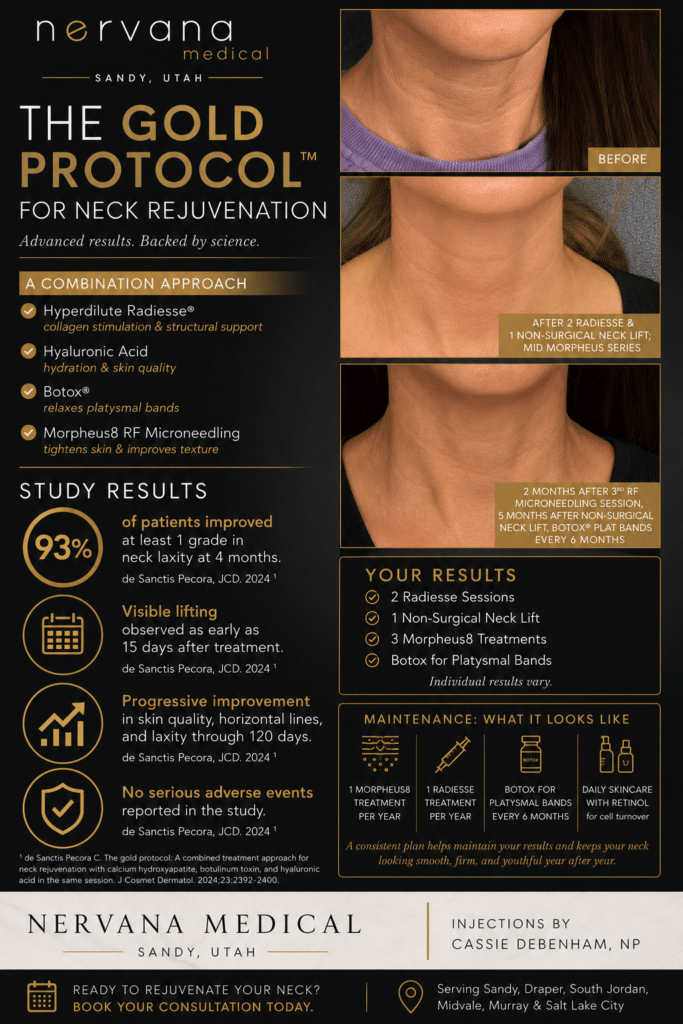
The first study, published in the Journal of Cosmetic Dermatology in 2024 by de Sanctis Pecora, described a single-syringe combination the author called a “gold protocol.” Fifteen women received calcium hydroxyapatite, incobotulinumtoxinA (a neuromodulator), and a cohesive hyaluronic acid, all diluted together and injected in one session, with the calcium hydroxyapatite hyperdiluted at roughly 1:3.
The logic is that the three agents have complementary mechanisms. The neuromodulator relaxes the superficial platysma fibers, the hyaluronic acid fills and smooths immediately, and the calcium hydroxyapatite stimulates new collagen over the following months. At four months, just over 93% of patients showed at least a one-grade improvement on a five-point neck laxity scale. A lifting effect was visible by 15 days, with continued improvement out to roughly 120 days, matching the known timeline of collagen building around the calcium hydroxyapatite microspheres. Side effects were mild and temporary, though every patient had some bruising.
The appeal is efficiency and completeness in one visit. The limitations are real, and the author is candid about them. It was a small, single-center pilot with no control group, and the results were graded by the treating investigator rather than a blinded reviewer.
This is where our “Non Surgical Neck Lift” service came from.
Study two: isolating the biostimulator and measuring the skin
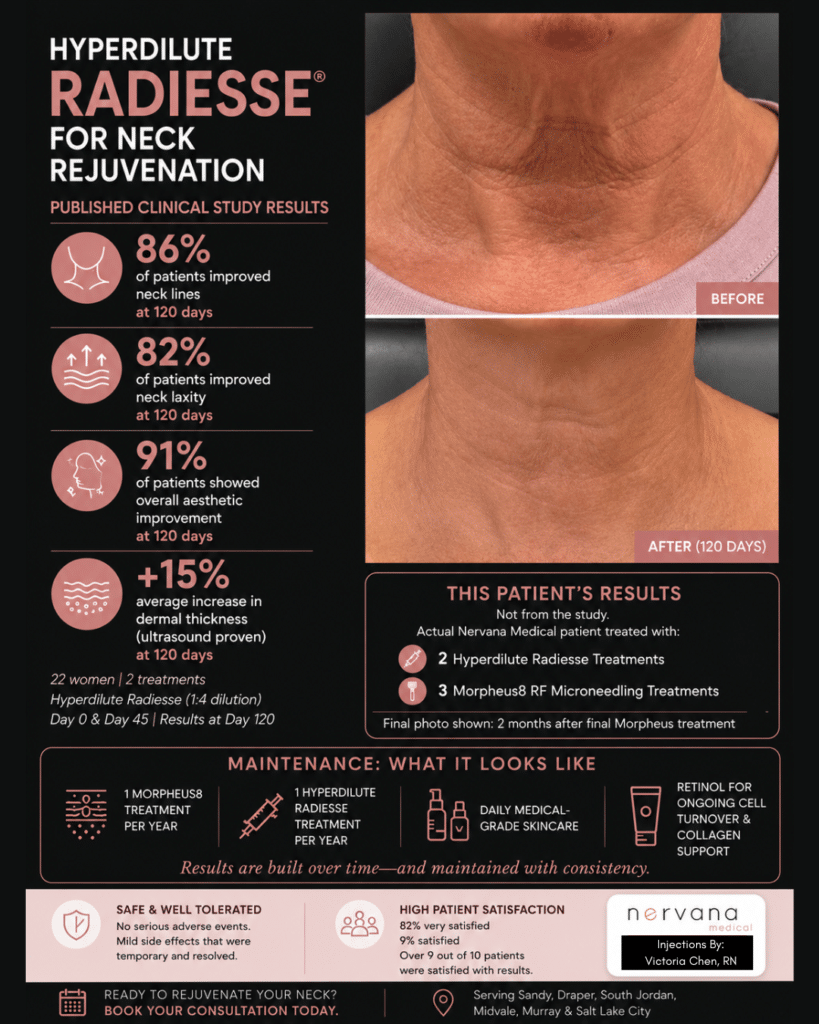
The second study, by Trindade de Almeida and colleagues in Clinical, Cosmetic and Investigational Dermatology in 2023, took a more controlled approach to a narrower question. What does hyperdiluted calcium hydroxyapatite do on its own? Twenty-two women with mild to moderate neck aging received the biostimulator hyperdiluted at 1:4, alone, across two sessions about six weeks apart.
What makes this study stronger is how it was assessed. Two blinded dermatologists graded standardized photos, and the researchers used high-frequency ultrasound to measure the actual thickness of the dermis at three points on the neck. By day 120, horizontal necklines had improved by at least one grade in 86% of participants, neck laxity in 82%, and overall aesthetic improvement was recorded in 91%. Mean dermal thickness increased by about 15%, with the largest gains laterally (up to 23% at the outer point). More than 80% reported being very satisfied, and adverse effects were minor and transient, with a single nodule that resolved with massage.
This is the study that shows the mechanism objectively. The skin did not just look better in photos. It measurably thickened, which is exactly what you would expect from a true collagen-stimulating treatment working in the dermis.
This is where our Radiesse 3 pack came from.
Study three: radiofrequency microneedling for skin and structure
The third paper, a 2022 review by Hendricks and Farhang in the Journal of Cosmetic Dermatology, surveys the dermatologic uses of Morpheus8 fractional radiofrequency microneedling. Rather than reporting one trial, it gathers the evidence for how the technology works and where it helps.
Radiofrequency energy heats the dermis and triggers the same regenerative cascade a biostimulator does, namely new collagen, new elastin, and new blood vessels, leading to dermal contraction and thickening. Because the energy is chromophore-independent, it can be used safely across all skin types with a lower risk of pigment changes than many lasers. What makes it especially relevant to the neck and jawline is depth. The microneedles can be set from about 0.5 mm up to 7 mm, which means a single device can resurface thin skin and remodel the deeper subdermal fat that drives jowl and submental fullness. The review highlights combination studies in which radiofrequency microneedling paired with bipolar radiofrequency produced significant, blinded-investigator-rated improvement in jowl and neck laxity, with high satisfaction.
As a review, its strength is breadth rather than a single controlled result, and several of the studies it cites are small. But the throughline is consistent. Radiofrequency microneedling addresses the structural and textural layers of the neck that injectables alone cannot reach.
What the three studies tell us together
Read individually, each has a gap. The combination injectable study was not blinded. The monotherapy study tested only one product. The microneedling paper is a review built partly on small trials. Read together, they are complementary in the same way the treatments are.
The Trindade de Almeida study supplies the objective proof that biostimulation rebuilds the dermis, and that ultrasound can measure it. The de Sanctis Pecora study layers that biostimulation with a neuromodulator and a hyaluronic acid to address the muscle and the surface lines, and to give patients something visible early while collagen quietly builds underneath. The Hendricks and Farhang review adds a non-injectable tool that tightens skin and remodels deep fat from the outside in. Different layers, different mechanisms, one coordinated result.
A few honest caveats matter. All three were small or review-level, and none was a large randomized controlled trial. The two calcium hydroxyapatite studies were supported by the product manufacturer. Results varied between individuals. In the monotherapy study, the two patients who did not respond well both had hypothyroidism, a reminder that whole-person health affects aesthetic outcomes. These are encouraging, consistent findings, not guarantees.
How we approach the neck at Nervana
We treat the neck as multifactorial, because it is. The skin, the platysma, and the deeper fat are aging on different timelines, and no single tool corrects all three. So rather than asking which one product to use, we ask which layers are actually driving the way a particular neck looks, and then we combine the tools that match. In practice that usually means some mix of biostimulators to rebuild collagen and dermal thickness, neurotoxins to relax the platysmal bands and horizontal lines, and radiofrequency microneedling to tighten skin and remodel the subdermal fat.
This is where being an integrative med spa in Sandy, UT actually changes the plan. The same logic that connects three modalities on the neck also connects skin, hormones, and overall wellness, and thin, stalled skin is not always a purely topical problem. On the aesthetic side, our collagen-stimulating treatments, neuromodulators, and microneedling treatments are exactly the tools these studies put under the microscope. Which ones we use, and in what order, is designed for your anatomy rather than to a one-size protocol.
Frequently Asked Questions
What is the best treatment for neck rejuvenation?
There is rarely a single best treatment, because the neck ages in layers. The research points toward combining approaches: a biostimulator for skin quality and dermal thickness, a neuromodulator for muscle-driven bands and lines, and radiofrequency microneedling for skin tightening and deeper fat. A consultation determines which of those concerns is actually present for you.
Does calcium hydroxyapatite actually thicken the skin on the neck?
In the 2023 Trindade de Almeida study, ultrasound showed mean dermal thickness increased by about 15% after two sessions of hyperdiluted calcium hydroxyapatite, with the largest gains on the outer neck. It works as a biostimulator, prompting your own collagen rather than simply adding volume.
What does RF microneedling do for the neck that injectables cannot?
Radiofrequency microneedling delivers heat at adjustable depths, which lets it tighten skin and remodel the deeper subdermal fat that contributes to jowl and submental fullness. Injectables address volume, muscle, and dermal collagen, but they do not contract skin or reduce deep fat the way radiofrequency can.
How soon will I see results from neck rejuvenation?
It depends on the approach. Biostimulators and radiofrequency build collagen gradually, with improvement developing over roughly three to four months. When a neuromodulator and hyaluronic acid are part of the plan, some smoothing and lifting can appear within the first couple of weeks while the collagen effect continues underneath.
Is neck rejuvenation safe?
Across these studies, adverse effects were mild and temporary, mostly bruising or transient tenderness. Radiofrequency microneedling also has a strong safety record across skin types. As with any treatment, safety depends heavily on injector experience and respecting the neck’s danger zones.
Book a Neck Rejuvenation Consultation in Sandy, UT
Your neck has its own anatomy, and the right plan starts with understanding it rather than guessing. If you are considering neck rejuvenation, book a consultation at Nervana Medical in Sandy, UT, and we will walk through which layers are driving the changes you are seeing, and which combination of treatments, if any, makes sense for you.