
Knee osteoarthritis has been treated at the knee for a very long time. A 2024 editorial in the New England Journal of Medicine asked whether some of it should be treated systemically. At Nervana Medical, an integrative practice in Sandy, UT, where medical weight loss and joint injection therapy live under the same roof, that question comes up in our exam rooms all the time. Below: what the STEP 9 semaglutide trial actually found, what the editorial argued, what the research does not show yet, and how we think about GLP-1 medications alongside knee injections.
In this article
- Why Knee Osteoarthritis Needs Better Options
- What the STEP 9 Trial Found
- What the NEJM Editorial Argued: Load and Metabolism
- What the Evidence Does Not Show (Yet)
- Where GLP-1s Fit Alongside Knee Injections
- Frequently Asked Questions
- Talk to Us About the Whole Picture in Sandy, UT
- Sources
Why Knee Osteoarthritis Needs Better Options
Osteoarthritis is one of the world’s leading causes of disability. In his NEJM editorial, Dr. David Felson of Boston University notes that roughly 4.3% of adults have painful knee osteoarthritis with pain on most days, and the numbers are much higher in older adults.
The standard nonsurgical toolkit has real limits. NSAIDs can be dangerous for the older patients most affected by the disease. Exercise helps, but it is hard to stick with when the joint hurts. Acetaminophen has only modest benefit and has been dropped from some treatment guidelines.
What the STEP 9 Trial Found
Who Was Studied
STEP 9 (Bliddal et al., NEJM, October 2024) was a 68-week, double-blind, randomized, placebo-controlled trial at 61 sites in 11 countries. It enrolled 407 adults with obesity (BMI of 30 or higher) and moderate knee osteoarthritis with at least moderate pain. Participants received either once-weekly semaglutide 2.4 mg or placebo, and both groups received counseling on a reduced-calorie diet and physical activity.
This was a specific population: the average BMI was 40.3, 41% had severe obesity (BMI 40 or higher), the average age was 56, about 82% were women, and baseline pain scores were high (average WOMAC pain score 70.9 out of 100).
The Results
At 68 weeks:
- Body weight: −13.7% with semaglutide vs. −3.2% with placebo.
- Knee pain (WOMAC, 0–100): −41.7 points with semaglutide vs. −27.5 points with placebo, an estimated difference of about 14 points.
- Physical function (SF-36): +12.0 points with semaglutide vs. +6.5 with placebo.
- Pain medication: Analgesic use fell more in the semaglutide group, so the pain improvement was not explained by people taking more pain relievers.
What the Headlines Tend to Leave Out
The placebo group improved substantially too, most likely reflecting the diet and activity counseling, modest weight loss, and the placebo effect. The added benefit of semaglutide was the roughly 14-point difference, not the full 41.7 points.
Side effects also mattered. Adverse events led to permanent discontinuation in 6.7% of the semaglutide group vs. 3.0% on placebo, most often because of gastrointestinal effects. Serious adverse events were similar between groups. The trial was funded by Novo Nordisk, the manufacturer of semaglutide.
What the NEJM Editorial Argued: Load and Metabolism
Felson called the size of the effect “remarkable.” He estimated it at a Cohen’s d of 0.8, while most nonsurgical knee OA treatments come in below 0.5.
He also laid out two ways obesity drives knee osteoarthritis:
- Mechanical load. Extra weight increases stress across the joint.
- Metabolic signaling. Visceral fat releases adipocytokines and other inflammatory mediators that increase pain.
That second point is why this is a metabolic conversation and not only a mechanical one. GLP-1 receptor agonists have anti-inflammatory and immune-modulating effects, and GLP-1 receptors are present in the synovium, bone, and cartilage. Felson raised the possibility that some benefit comes from effects beyond weight loss, acting either in the nervous system or in the joint itself. That remains a hypothesis. He also pointed to an observational study (Zhu et al., 2023) of people with type 2 diabetes and knee OA, in which GLP-1 users lost more weight, had fewer knee surgeries, and showed slower cartilage loss on MRI. Because it was observational, it shows an association, not proof.
What the Evidence Does Not Show (Yet)
This is where honesty matters most:
- GLP-1s are not FDA-approved to treat knee osteoarthritis. Wegovy (semaglutide 2.4 mg) is FDA-approved for chronic weight management, cardiovascular risk reduction in certain adults, and a specific form of liver disease (MASH). Knee OA is not a labeled indication.
- The benefit was shown in people with obesity. Whether similar results hold for people with lower BMI or milder pain is unknown, and Felson says so directly.
- No one has shown that GLP-1s rebuild cartilage. STEP 9 did not include follow-up imaging or measure inflammatory markers, so the authors state it could not determine the drug’s effect on the disease process. They considered weight reduction “most likely a major contributor.”
- One drug, one dose, one timeframe. STEP 9 tested semaglutide 2.4 mg for 68 weeks. An earlier trial of liraglutide, which produced only modest weight loss, found no significant pain difference versus placebo. Results should not be assumed to transfer automatically to every GLP-1, dose, or formulation.
- Benefits may depend on staying on treatment. Outcomes were not tracked after the trial ended, and prior studies show weight regain after semaglutide is stopped.
- Results vary. Averages describe groups, not individuals.
Where GLP-1s Fit Alongside Knee Injections
A GLP-1 is not an osteoarthritis drug, and it does not replace injection therapy, strength work, or a real orthopedic evaluation. For many patients with knee OA and excess weight, though, joint care and metabolic care are the same conversation.
Our providers bring backgrounds across multiple specialties in traditional medicine, including intensive care, emergency medicine, and pain management, along with integrative approaches. Depending on your evaluation, a plan might include:
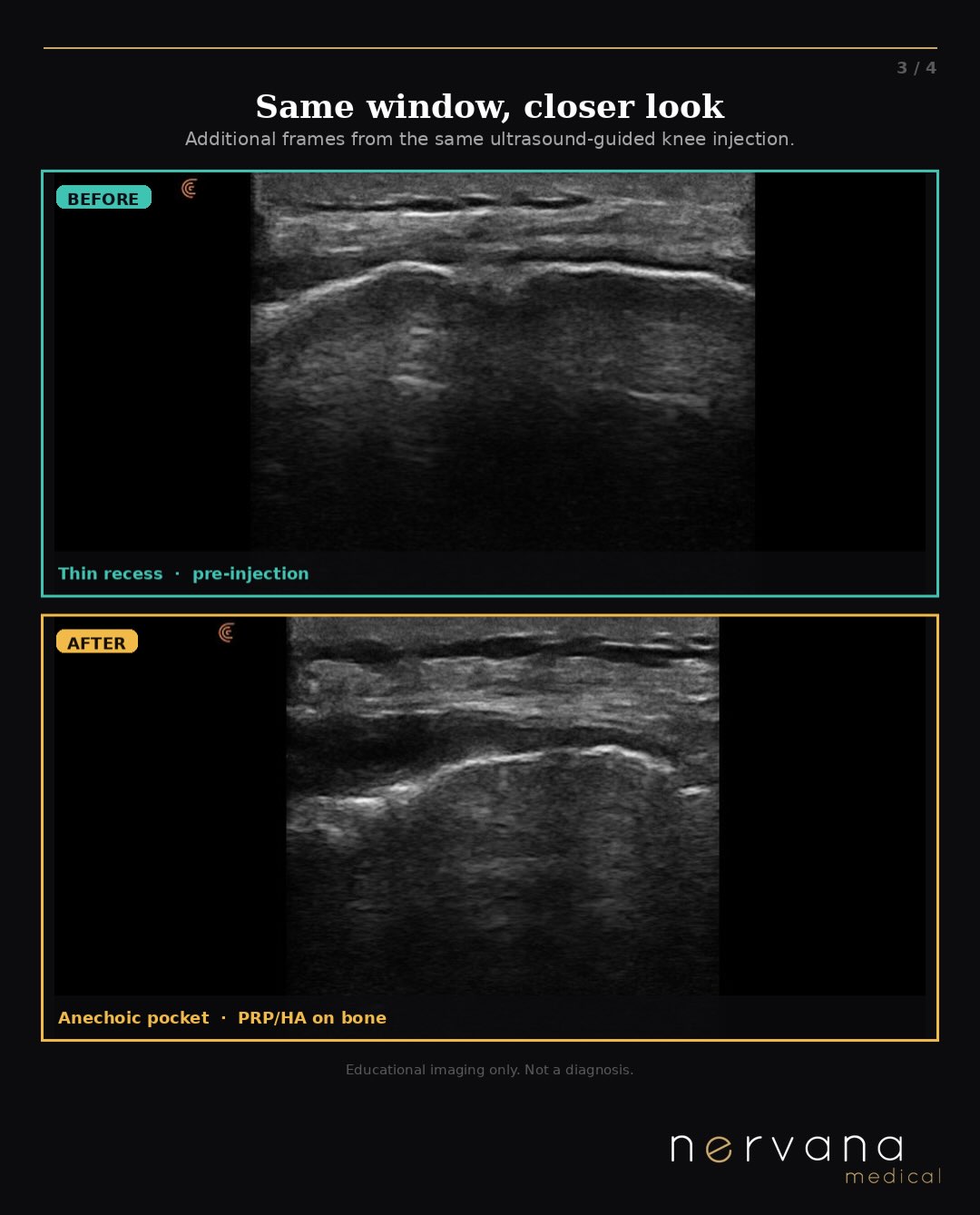
- Ultrasound-guided knee injections that let us see the anatomy and confirm placement in real time, including hyaluronic acid (Durolane® and Supartz FX™), PRP/PRF joint injections, or a PRP + HA combination when appropriate. For a deeper look at those options, read Knee Osteoarthritis: Understanding Your Options from Hyaluronic Acid to PRP Therapy.
- Medical weight loss for patients who qualify, with GLP-1 or GLP-1/GIP medications such as semaglutide or tirzepatide, nutrition guidance, and regular provider follow-up.
- Strengthening and low-impact movement, which remain a foundation of knee OA care.
Frequently Asked Questions
Is semaglutide FDA-approved for knee osteoarthritis?
No. Semaglutide 2.4 mg (Wegovy) is approved for chronic weight management and a few other indications, but not knee OA. STEP 9 is meaningful evidence of reduced knee pain in adults with obesity, not an approval for arthritis treatment.
Will a GLP-1 help my knee pain if I don’t have obesity?
We don’t know. STEP 9 enrolled adults with a BMI of 30 or higher (average 40.3) and moderate-to-severe pain. Researchers, including the NEJM editorialist, have said this still needs to be studied in people without obesity.
Can GLP-1 medications reverse cartilage damage?
That has not been shown. STEP 9 did not include follow-up imaging, and the observational MRI findings from the Zhu et al. study suggest an association, not proof. Right now the strongest evidence is for reduced pain and better function alongside weight loss.
Can I combine a GLP-1 with knee injections?
They address different parts of the problem and can be part of the same plan. Whether that fits you depends on your health history, imaging, and goals, which is what a consultation is for.
Talk to Us About the Whole Picture in Sandy, UT
If knee pain is the thing keeping you from moving, you do not have to pick between a joint plan and a metabolic plan. Our team can evaluate your knee, talk through injection options, and discuss whether medical weight loss makes sense for you. Book a consultation at Nervana Medical in Sandy, UT, or call/text (801) 335-5243.
Medical disclaimer: This article is for educational purposes only and is not medical advice. GLP-1 medications are not FDA-approved specifically to treat knee osteoarthritis, and individual results vary. Talk with a qualified healthcare provider about your own health history before starting, stopping, or changing any treatment.
Related reading
- Knee Osteoarthritis: Understanding Your Options from Hyaluronic Acid to PRP Therapy
- Orthopedic Joint Injections in Sandy, UT
- Medical Weight Loss in Sandy, UT
Watch
- GLP-1 and Knee Osteoarthritis | Sandy Utah (YouTube Short)
- HA Joint Injections | Orthopedic Pain Relief Sandy Utah (YouTube Short)
- Knee Injections | Sandy Utah (YouTube Short)
- Ultrasound-guided PRP + HA knee injection, before and after (Instagram)
Sources
- Felson DT. Glucagon-Like Peptide-1 Receptor Agonists and Osteoarthritis. N Engl J Med. 2024;391(17):1643–1644. doi:10.1056/NEJMe2409972. https://doi.org/10.1056/NEJMe2409972
- Bliddal H, Bays H, Czernichow S, et al. Once-Weekly Semaglutide in Persons with Obesity and Knee Osteoarthritis (STEP 9). N Engl J Med. 2024;391(17):1573–1583. doi:10.1056/NEJMoa2403664. https://doi.org/10.1056/NEJMoa2403664 (ClinicalTrials.gov NCT05064735: https://clinicaltrials.gov/study/NCT05064735)
- Zhu H, Zhou L, Wang Q, et al. Glucagon-like peptide-1 receptor agonists as a disease-modifying therapy for knee osteoarthritis mediated by weight loss: findings from the Shanghai Osteoarthritis Cohort. Ann Rheum Dis. 2023;82(9):1218–1226. doi:10.1136/ard-2023-223845. https://doi.org/10.1136/ard-2023-223845
- WEGOVY (semaglutide) prescribing information, DailyMed, U.S. National Library of Medicine. https://dailymed.nlm.nih.gov/dailymed/drugInfo.cfm?setid=ee06186f-2aa3-4990-a760-757579d8f77b